
iSWOOP: A Collaboration with the National Park Service Integrating Design Methods and Studio-based Learning with Scientific Inquiry and Field Research
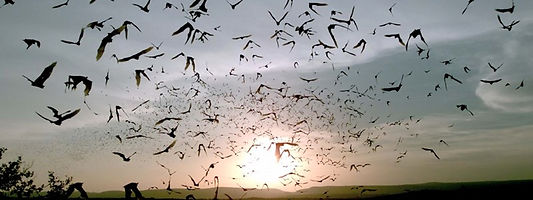
Interpreters and Scientists Working On-site at Our Parks (iSWOOP) is a celebration of learning that involves college students, National Park rangers, biologists, and educational researchers in studies of bats roosting in Carlsbad Cavern. On summer evenings at dusk, park visitors watch in awe as bats emerge from the mouth of the cave in a spectacular swarm, heading out to feast on insects in the arid environment. Rangers become storytellers as they explain ecological benefits of the creatures’ foraging and interpret the bats’ behaviors. Biologists working on-site study flight patterns, the phenomenal strength of the bats’ paper-thin wings, and population dynamics of the bat colony. The scientists collect data through laser scanners and thermal cameras placed deep in the cave and high-speed cameras tracking rapid wingbeats through the skies. The field researchers then bring the digital recordings home to a studio-classroom, where students in a specially designed Scientific Visualization course learn representational strategies and workflows for translating the numerical data into dynamic imagery and vibrant graphics. The students benefit from critiques with both peers and seasoned practitioners, who have both artistic and scientific expertise. Collaborators sometimes include professional data analysts and animators, along with the teachers and a broadening range of undergraduate students. The work proceeds iteratively toward high-fidelity realizations depicting the bats and their environment. Selected visual results become grist for the park interpreters, as they incorporate the researchers’ findings into narratives about bats for the general public. iSWOOP is funded through a grant from the National Science Foundation.
Vice Provost
Rhode Island School of Design
Carol Strohecker is vice provost at the Rhode Island School of Design (RISD). She was a founding co-principal investigator of the SEAD network for Sciences, Engineering, Arts and Design, spawned in 2011 through grants from the National Science Foundation. From 2006 until 2013, she was inaugural director of the Center for Design Innovation, a multi-campus research center of the University of North Carolina system. Previously she was principal investigator of the Everyday Learning research group at Media Lab Europe, the European research partner of the MIT Media Lab. Strohecker’s collaborative work in interactive media tools and methods has resulted in four US patents. Her awards also include fellowships with the Artists Foundation of the Massachusetts Council for the Arts and Humanities, the US National Endowment for the Arts, and the Harvard University Graduate School of Design.
Assistant Professor and Design Researcher
Winston-Salem State University and UNC Center for Design Innovation
A native of Bulgaria, Dr. Nickolay Hristov received his BS from the University of Maine in Zoology and Wildlife Ecology in 1997. He received his MS and PhD in animal communication from Wake Forest University before completing postdoctoral work at Boston University with Thomas Kunz and at Brown University with Sharon Swartz. In 2009, Dr. Hristov joined the Center for Design Innovation, a research center of the University of North Carolina system. His expertise includes zoology, ecology, evolutionary biology, and science of motion. He is also fluent in digital techniques for motion analysis and visualization as well as advanced technologies like high-speed videography, laser scanning, and thermal imaging. His work effortlessly spans the film set and art and design studios, the research laboratory and the outdoors, and the deserts of the American West to Eastern Europe.

