
CODE as Form / FORM as Code
An approach to teaching computer science, material science and digital fabrication in a creative context: Teaching science, mathematics and technology poses a challenge in colleges of art and design and has a reputation of being difficult and sometimes even useless. However, in order for artists, designers and architects to be able to operate in today's world they need to know how to deploy new technologies in design.
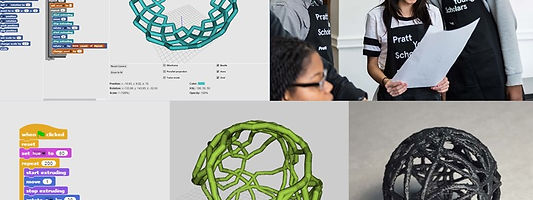
The proposal for this panel on 'Technology’s Transformative Role in [Art + Design] Education' reports on novel ways of teaching STEM subjects in a creative environment. Rooted in the domain of 'Creative Learning', this project started as a pilot with architecture students in the undergraduate school of architecture at Pratt. The goal consists of teaching programming to create sculptural designs in order to empower students with this way of designing. The software prototype developed for this purpose is called 'Beetle Blocks', a visual programming language for 3d designs.
Students learn fundamental concepts in computer science by using short programs or algorithms to design 3-dimensional structures. The goal is to create sculptural objects in a fun way and teach computer science at the same time. The 2-dimensional and 3-dimensional designs are printed with small digital fabrication machines. The material science of the used materials is taught in a parallel seminar on chemistry.
During a two day workshop the students taught the software and fabrication to the 'Pratt Young Scholars', members of an initiative that awards three-year scholarships to Brooklyn high school students.
Assistant Professor of Design and Technology
Pratt Institute, School of Architecture
Duks Koschitz completed his PhD in the Design & Computation Group at MIT and wrote on curved crease paper folding, specifically on the work of computer scientist David A. Huffman. He is an associate professor of Design and Technology at Pratt Institute, focusing on integrating technology in an undergraduate curriculum that supports students in developing design skills. He conducts research in creative learning and, with Eric Rosenbaum, developed Beetle Blocks, a software that teaches algorithmic thinking to generate forms. Koschitz has held several research positions at MIT and at the E.T.H. in Zurich in 2011. He graduated from the Technical University in Vienna in 1998.
Koschitz co-founded sparc, a design collaborative, which won top prize in the London 2008 competition held by the River Thames Gallery and first prize in the 2010 Gillette Sculpture Competition in Boston. From 2000 to 2007 Koschitz was the lead designer at NMDA.
Professor, Director of the Center for Art, Design, and Community Engagement K-12
Pratt Institute
Aileen Wilson’s research interests include the role of art and design in youth and community development. A professor of Art and Design Education at Pratt Institute, Wilson earned a BA in Printmaking and Painting from Gray’s School of Art, in Aberdeen, Scotland, and an MA in Printmaking from Chelsea School of Art, in London. She earned her EdD in Art and Art Education from the Teacher’s College at Columbia University, in New York. She was confirmed as a Fulbright Specialist Roster candidate in 2010 through 2015 and was a Fulbright Specialist grantee to Iceland in 2011 and 2012.
Her publications include Building_space_with_words, an interactive, multimedia installation exploring the relationship between physical and virtual space that she co-authored with Anne-Laure Fayard, published in Le.
Associate Professor
Pratt Institute
Cindie Kehlet has a PhD in Physical Chemistry from the University of Aarhus, Denmark, and is an associate professor of chemistry at Pratt Institute in New York. Trained in nuclear magnetic resonance (NMR) spectroscopy, she spent three years at the technical university in Munich during her studies. In 2006 she received the Danish Young NMR researcher prize. Since joining Pratt she has developed several chemistry- and art-related courses for nonmajors, among them Chemistry of Pigments and Nature of Color. These courses are rigorous in science and developed based on proven pedagogy. She has been mentoring several graduate and undergraduate students in science- and art-related research projects. Her research is focused on the noninvasive investigation of artist’s materials with a specific focus on the application of unilateral NMR.


